Chapter One: The Estate Box
The box came up the mountain on a Tuesday, wedged between sacks of carrots in the back of a jeepney, and Anselmo signed for it the way he signed for everything: neatly, and without reading.
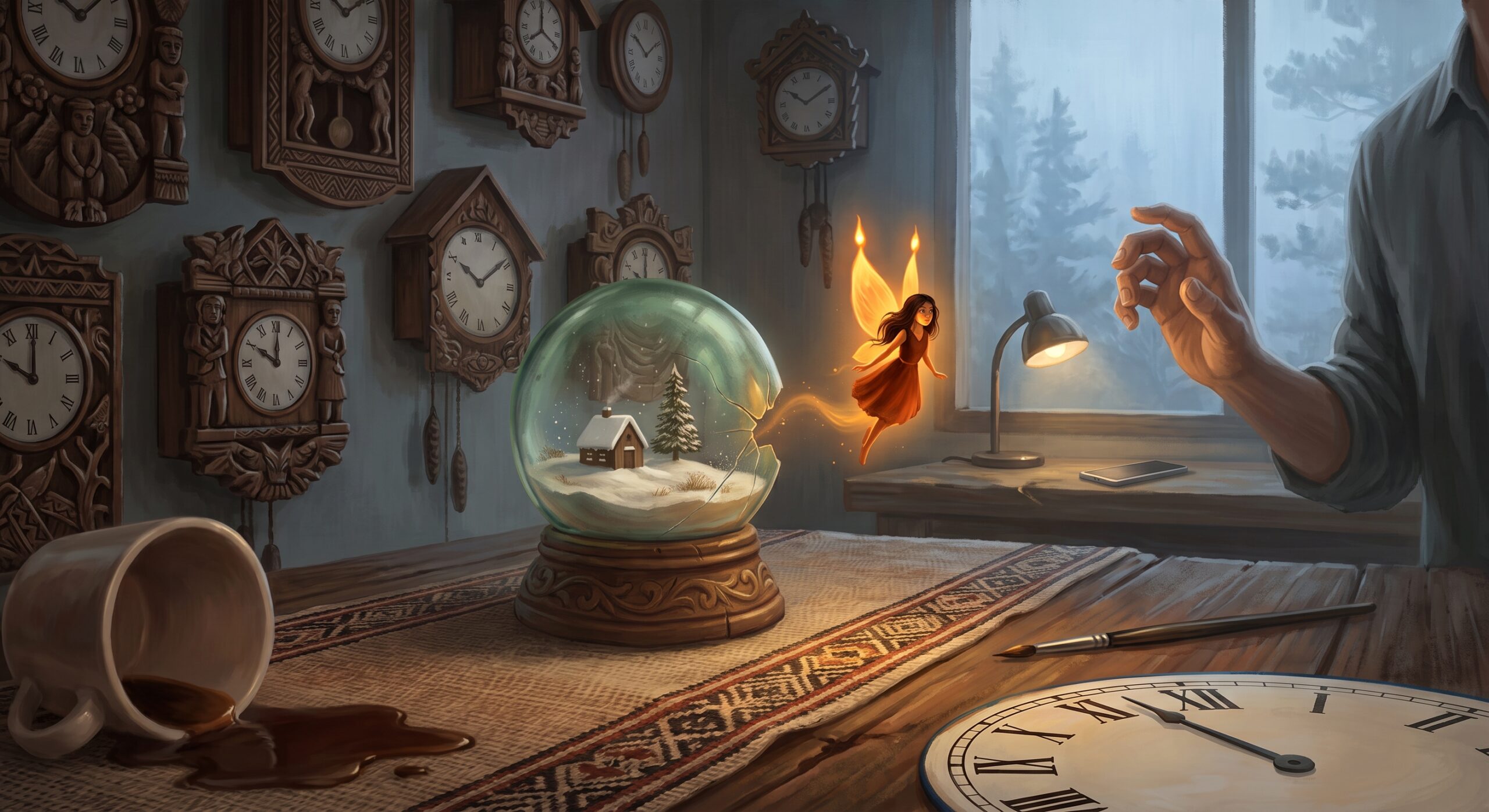
His workshop was a narrow room above a bakery on a hill street in Baguio, where the fog came in each morning and lay against the window like a cat that wanted in. The room smelled of brass polish, old oil and, faintly, pandesal. Eleven clocks lived on the walls. None of them agreed. The tall one by the door ran four minutes fast; the mantel clock with the chipped face ran slow and had done so, out of what Anselmo could only assume was spite, since before he bought it. He knew each one’s error to the second. That was the point. A clock that was wrong in a way you understood was better company than most people.
There was a twelfth clock, a small brass travel clock on the high shelf, which had stopped at twenty past six some years ago. He had never opened it. It was the only repair in the room he had never started, and he dusted around it the way you’d step around a sleeping dog.
His phone lay face-down on the same shelf. It buzzed twice while he poured his coffee, the short double buzz of a message, and he let it. There were eleven unread messages in the thread already, all from the same name. He knew roughly what they said. Knowing roughly was enough.
He set the box on the bench, poured his coffee, and went back to the dial he’d been repainting since dawn. It was a small enamel face from the 1920s with its numerals worn to ghosts. He worked with a brush that was mostly a single hair, laying the black down in thin coats and letting each one dry before the next. You couldn’t hurry a numeral. If you hurried it, the seven came out looking like it had somewhere better to be.
At noon he opened the box.
Boxes from estates were always the same. Someone lived for eighty years, and what was left of them arrived in a carton that had once held corned beef. This one had come from the old Ilagan house down in La Trinidad. The lady of the house had died in November, and her nephews, in the way of nephews, wanted everything appraised and nothing kept.
A mantel clock, no key. A pocket watch with cracked glass. A music box with three teeth missing from its comb, so the song inside would play with gaps in it, like someone humming who keeps forgetting the words. He set that one aside with something close to tenderness. He could fix a music box. You took out the cylinder, studied the pins, and worked out what the song was meant to be from what was left of it. It was the most patient kind of listening he knew.
At the bottom, wrapped in a dish towel, was a snow globe.
It was old, older than the clocks. The base was carved wood, and the glass was thick and slightly green, the way old glass is. Inside stood a little cottage with a painted door and a single pine, both glued to a white hill. The water had long since gone; a crack ran along the seam where the dome met the base, and whatever had once filled it had leaked out years ago. The snow lay dry and dull at the bottom, like dust in a forgotten drawer.
“Well,” Anselmo said to the globe. “You’ve had a hard life.”
He turned it in the light to judge the crack. The glass was cold and heavier than it looked, with tiny bubbles trapped in it like held breath, and the dry snow inside slid across the hill with a faint hiss, like sugar poured into a bowl. Something inside moved.
He stopped. He was a careful man, and careful men don’t trust the first thing they see. He held the globe still. He turned it a quarter-inch to the left.
There was a figure in the cottage doorway. He had taken it for part of the painting: a smudge of gold, a decoration. It was the size of the top joint of his thumb. It had arms and a face, and wings folded down its back like a closed fan.
As he watched, it lifted one hand and waved.
For one long second there was no explanation. There was only his own pulse, loud in his ears and going like a clock wound too tight, and a tiny gold hand raised toward him through the glass. His elbow caught his coffee cup. It rocked, spilled a brown tongue across the bench, and he didn’t look at it. He couldn’t look at anything else.
Then the careful part of him came back, the way it always did, and closed over the moment like water.
Anselmo set the globe down very gently on the bench and took three steps back.
There was an explanation. There was always an explanation. Light through old glass did strange things; he had once spent a whole afternoon convinced a pocket watch was ticking backwards, when the trouble was a mirror behind him. He hadn’t slept well. It was nearly Christmas, and the bakery downstairs had been running the ovens since four, and maybe the yeast was getting into the walls. He said this last thought out loud, to the tall clock, which ticked four minutes ahead of him and offered no opinion.
When he looked back, the figure was standing at the crack, both hands pressed to the glass. Then she turned sideways, folded herself thinner than anything had a right to be, and slipped through.
The warmth came first.
It wasn’t dramatic. It was the warmth of a kitchen in December, of opening an oven to check on bread, a soft wave of it against his face. With it came a smell he knew and couldn’t place at first: woodsmoke, and candle wax, and sugar just beginning to turn to caramel. It smelled like the bakery downstairs at four in the morning, like the warmest thing he already knew. She rose out of the crack in a little cloud of dry, glittering snow and hung in the air above the bench, glowing a deep amber, like a candle seen through honey.
She shook herself. Flakes fell from her hair onto his half-painted dial. She looked down at them, then up at him, and laughed. It was a small sound, like a spoon tapped against a teacup.
Anselmo did not move.
She didn’t seem to mind. She flew a slow circle around the room, looking at everything. She landed on the mantel clock’s chipped face and knocked on it with one knuckle, the way you’d knock on a door, then looked over at him as if to ask whether anyone was home. She sat for a while on the tall clock’s pendulum and let it swing her. When she passed the window, the fog on the glass cleared in a little oval where her warmth touched it.
The magnifying loupe on his eye fogged over. He took it off and wiped it on his shirt, and it fogged again. On the bench, the drop of clock oil he had set out that morning had gone soft and begun to spread.
He went to the window and opened it. Cold mountain air rolled in, smelling of pine. He stood in it and felt slightly better.
When he turned around she was sitting on the music box, three feet from him, swinging her legs. Her face was tilted up toward his, open and curious, as though he were the interesting thing in the room. She drew a breath, and her lips parted, and he understood with sudden certainty that she was about to speak to him.
“You,” Anselmo said loudly to the mantel clock, “are running slow again.”
He crossed the room and opened its case, though there was nothing to fix. He knew exactly how slow it ran. He kept his back to the bench and wound the clock with great concentration, and by the time he finished, the moment had passed.
That evening he opened his repair book and wrote up the box, item by item, in his small square hand.
Mantel clock, no key. Pocket watch, crystal cracked. Music box, three teeth missing from comb.
Snow globe, cracked at seam. Contents:
He looked at the pen for a long time.
She was on the lamp at the far end of the bench, sitting in the circle of its light like it was a hearth. Her glow reached the high shelf and touched the stopped travel clock, and he found he didn’t want to look at that either. She seemed tired. Her glow had settled to a low gold, and she was watching him with her chin in her hands.
He did not ask her name. A name was a question, and a question wanted an answer, and once you had an answer you had a person, and a person could turn around at the door one day and not come back. He did not think this in words. He only felt a quiet certainty that it would be better not to ask.
Dry snow from the broken globe was still caught in the grain of the bench. A flake had landed on the open page.
Contents: one figure, he wrote. Then, after a moment: Neve.
It was the Italian word for snow. It suited her, he decided, and it didn’t belong to her. It belonged to him, and was safe.
He did not say it aloud. From the lamp, the figure tilted her head at the small scratch of the pen, as if she could hear what it was writing, which he decided meant yes.
On the high shelf, his phone lit up against the wood, a thin white line around its edges. Twelve now. He didn’t turn it over.
He did not sweep the snow from the bench that night. He left it where it had fallen, and turned off every light but hers.