Chapter Two: Too Much
My name is Tala. I wanted you to hear it first.
I should explain about the laughing.
I had been awake inside that globe for a long time before he opened the box. I felt the dish towel come away. I saw a face through the green glass, enormous and bent by the curve, frowning at me as though the glass owed it money. So I waved. It seemed friendly.
He put me down very gently, walked three steps away, and told the tall clock by the door that the yeast from the bakery was probably getting into the walls.
Yeast.
I have been mistaken for a lot of things in my life. A firefly. A reflection on a pot lid. Once, by a very tired cook at two in the morning, for her own sleeve catching fire. I had never been mistaken for a baking problem.
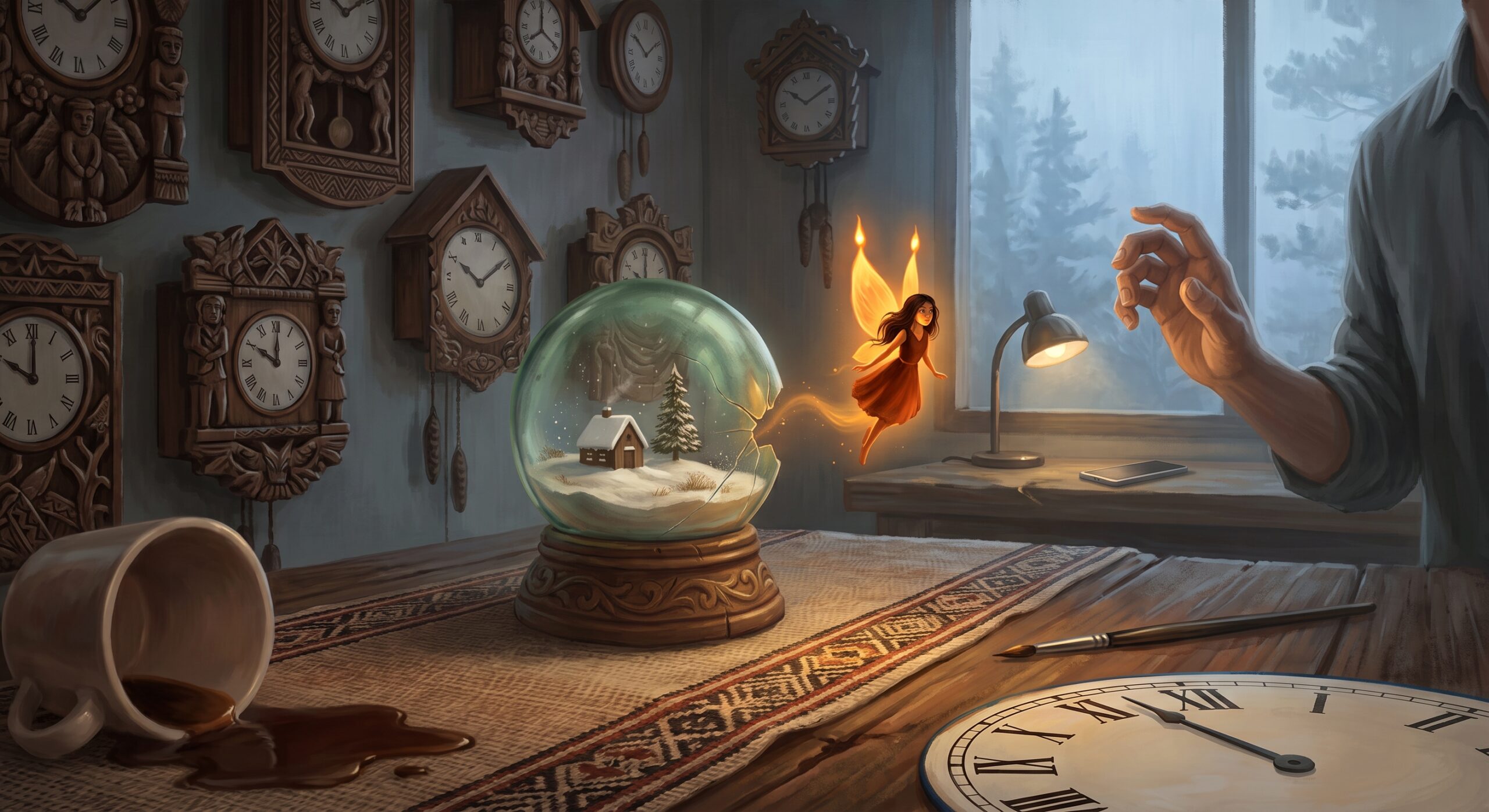
So when I finally squeezed out through the crack and shook the old snow from my hair, and there he was with coffee running across his bench, looking at me like I was something he’d need to file a complaint about, I laughed. I didn’t mean to be rude. It’s only that he was so serious. Serious people are always a little funny, if you’re kind about it.
He didn’t laugh back. That was all right. Not everyone does at first.
❄ ❄ ❄
I had decided my first word would be my name. It seemed like the polite way to begin.
I waited until he’d closed the window and calmed down a little. I sat on the music box, close enough to be heard, but not so close that he’d feel crowded. I looked up at him. I took a breath.
“You,” he said, “are running slow again.”
For one terrible second I thought he meant me. I’d been asleep in a dish towel for weeks, and I was still finding snow in my ears.
Then he opened the mantel clock and began to wind it as if the whole town depended on it, with his back to me, and I understood that he had been talking to the clock.
Which was worse, somehow.
I kept my name for another moment.
❄ ❄ ❄
By the second morning I had walked every inch of his bench. I fly when I have to, but mostly I walk. The bench is a whole country: a steel ruler for a bridge, a valley of loose screws, a dried coffee ring I go around like a lake. Behind it all, eleven clocks tick slightly out of step, so the room never has one heartbeat, only a soft, endless rain.
I had names for everyone in the room.
The tall clock by the door runs fast and always reaches the hour first, very pleased with himself. He is the Eager One. The mantel clock runs slow and sulks about it. He is the Grumpy One. A little cuckoo by the window only ever gets her bird halfway out, as if she’s forgotten what she came to say. I call her Almost.
I talk to them while he goes down for bread. They don’t answer. Neither does he, so I don’t take it personally.
The only one I didn’t name was the little brass clock on the high shelf. It stopped at twenty past six, and he dusts around it every morning without ever touching it. There’s nothing in this room he couldn’t fix. You don’t leave a clock stopped because you can’t. You leave it because you’re afraid of what time it will say when it starts again.
Naming it felt like naming someone who had already left the room.
His phone sits beside it, face-down, glowing at the edges every few hours. Someone keeps writing to a man who never writes back. That’s either very stubborn or very fond.
In my experience, it’s usually both.
❄ ❄ ❄
I’ll admit I narrate him. He’s very good to narrate.
And he’s reaching for the smallest brush in the jar, a bold choice at seven in the morning, folks. He’s lowering it to the dial. The crowd is silent. The seven is looking nervous. He pushes his hair out of his eyes with his wrist, because his fingers are oily. It falls right back. The crowd groans—
I do it under my breath. Mostly.
Here’s what I learned in three days of watching him.
He wears the same shirt every day. On the second day I thought it was yesterday’s. On the third I realized he owns several of the same one.
He hums when he concentrates. It isn’t a song, just three or four notes going looking for each other and never quite meeting, a little off-key. He doesn’t know he does it.
He talks to the brass. “There you are,” he says, to a screw that has finally turned. “Easy. Nobody’s rushing you.”
The first time I heard him say it, he smiled, and his eyes did it too, softening at the corners like the smile started there. It was for a screw. I counted it anyway. One.
His hands are long-fingered and careful, stained at the tips with brass and paint. They never hurry. He holds a pocket watch with a cracked face the way you’d hold a bird that has hit a window. He’ll spend an hour on a spring nobody will ever see.
He never talked to me like that. He talked to screws like that. But I thought, at least he knows how.
❄ ❄ ❄
The trouble is that I’m warm.
It isn’t something I do. It’s something I am, the way the bakery downstairs is bread. Wherever I sit, his loupe fogs and his oil wanders. Each time, he looks at me, says nothing, and opens the window again.
I tried to stay at the far end of the bench. I’m not a careless person.
The room smells of brass polish and cold coffee, and wherever I sit, faintly, of caramel.
But here is what I noticed. Every morning, his coffee cup ends up a little closer to wherever I’m sitting. On the second night, working late, he rested his left hand on the bench near my lamp, and for one moment he closed his eyes, the way you close them when you step into the sun. He has very long lashes. It seemed unfair, on a man who mostly looks at screws.
Then he opened them, picked up the lamp with me still on it, and moved us both to the far end of the bench.
He liked it. I know he did. He liked it the way you like the sun after a week of rain: for exactly one minute, and then you go and look for shade.
He watches me, too, when he thinks I’m not looking. Once I caught him studying me through his loupe, the way he studies a gear he hasn’t decided about. When I looked back, he became very interested in the ceiling. That afternoon I found a scrap of paper under his coffee cup: a small figure with folded wings, drawn in a few quick lines, and beside it, numbers.
❄ ❄ ❄
There’s something else I should tell you. The music box from the estate box is mine.
Not mine. Hers. It lived on the shelf above the stove in the house where I lived, and it played every evening while the rice cooked. I kept that kitchen’s fire company for a very long time. Fire gets lonely if no one is watching it. So do people. She used to say that, the lady of the house.
She said a lot of things. I’ll tell you about her when I’m ready. She deserves to be told properly.
On the second afternoon he took the music box apart and laid its cylinder under the lamp and hummed, looking for the three missing notes. Wrong. Wrong again. Closer.
I know those notes. I heard them every evening for forty years. I could have hummed them for him in a heartbeat.
I almost did. But some things you wait to be asked for.
❄ ❄ ❄
On the second morning, while he was downstairs buying pandesal, I read his book.
I can read. Nobody expects that. I learned over her shoulder, one recipe at a time, and then her grocery lists, and then, when her eyes got bad, the letters from her sister in Cebu, which I read aloud to her by the fire.
His book was lying open on the bench, a flake of the old snow still caught in its spine. His handwriting surprised me. I’d expected something stiff and careful, like his clocks. It isn’t. It leans a little, and it’s beautiful. Some letters he makes entirely his own way: his g’s loop back on themselves as if they’ve forgotten something, and he crosses every t with one long stroke, like he couldn’t bear to lift the pen.
Snow globe, cracked at seam. Contents: one figure. Neve.
I have been called a lot of things. I had never been contents.
I didn’t know what Neve meant. I said it quietly to the Grumpy One. It sounded like the beginning of a word that hadn’t decided what it wanted to be. Like never, with the end left off.
It’s a strange feeling, being named by someone who never asked. Like being handed a coat in the wrong size, very kindly.
I sat on the edge of his book for a while and let myself be sad about it. Only a little. Only until the bells finished. When I stood up, I’d left a small brown mark on the page, like the ring a cup leaves. I hoped he wouldn’t mind.
Then I decided what I always decide, because I have lived with people for a long time and I know they are mostly better than their worst afternoons.
He fixes things. People who fix things don’t touch what they don’t understand yet. They look first, for a long time, from every side. He hadn’t asked my name because he hadn’t finished looking.
And to be fair to him, a woman doesn’t climb out of a snow globe every Tuesday.
So I would give him time. I’d been giving it away for most of my life.
❄ ❄ ❄
On the third night I woke at two in the morning and the lamp was on.
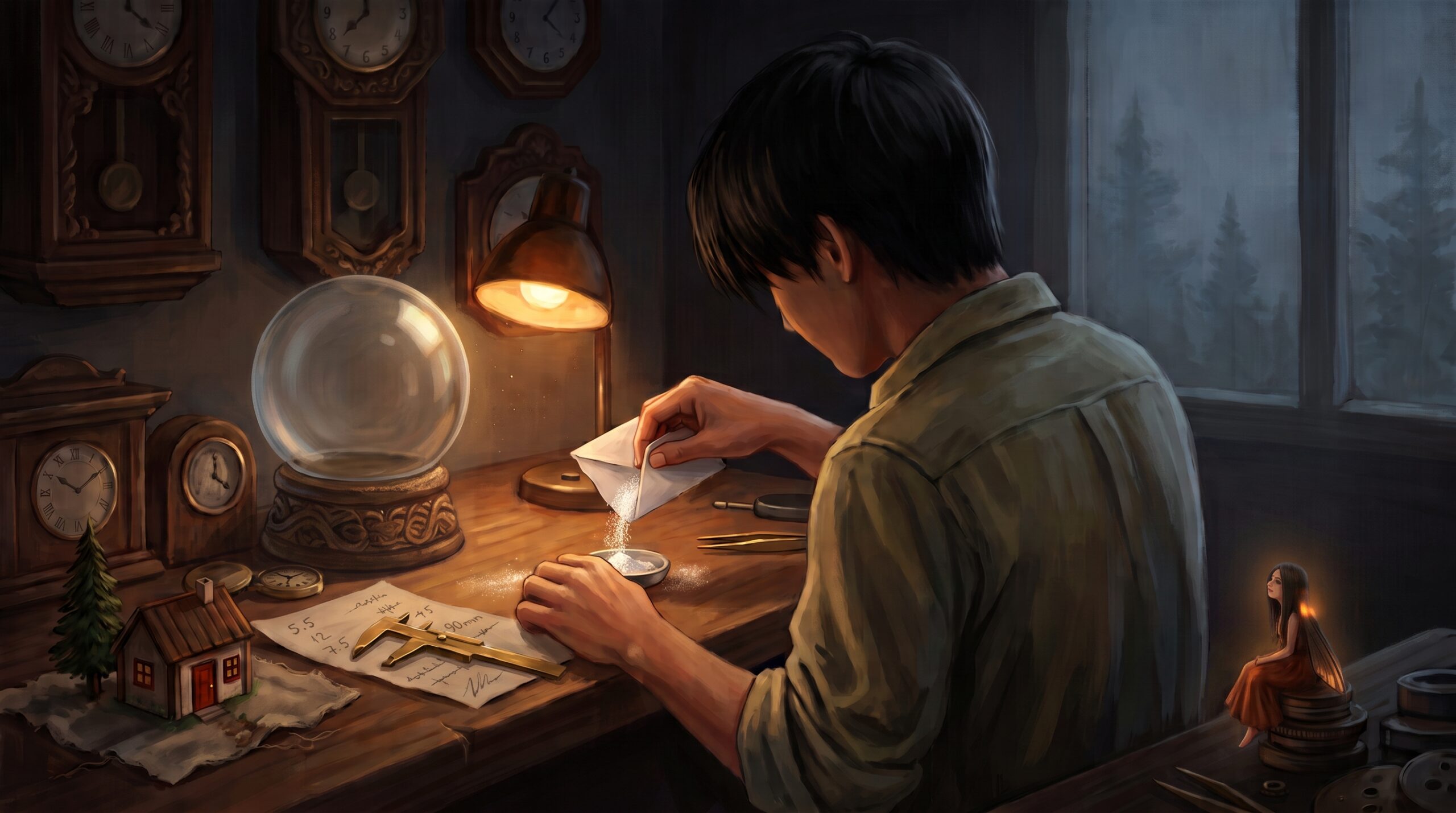
He was at the bench. He hadn’t heard me wake. The old globe lay in pieces in front of him: the cracked dome, the carved base, the little cottage and its pine set aside on a cloth like patients waiting their turn. He was measuring the base with a pair of calipers, writing numbers down, measuring again. Beside him stood a new sphere of glass, perfectly clear, not a bubble in it, catching the lamplight like a held breath.
He was humming. Three notes, looking for each other.
He took a tiny brush and began to paint a new door on the cottage, a warm red, the color of a stove when the fire is just right.
I knew that shape. The sphere, the base, the careful little world. I had lived inside one before, and I knew exactly how big the world becomes when it is that shape.
I didn’t move. For a moment my light went small, the way a candle does when a door opens somewhere in the house. Then it steadied.
He was being so careful. He was being so gentle.
He tipped a paper envelope over a dish, and something fine and white sifted out, soft as flour, catching the light as it fell.
He was making snow.